Why hearing aids need more than volume
When most people first think about hearing loss, the obvious solution seems to be volume. If sounds have become quieter, make them louder.
That is part of what a hearing aid does, but it is not the whole problem.
With common age-related sensorineural hearing loss, people can lose more than their sensitivity to quiet sounds. The damaged hearing system can also become worse at separating sounds that arrive at the same time. That is why someone can say: “I can hear everyone talking. I just cannot make out what they are saying.”
Imagine sitting in a restaurant. The person opposite you is speaking, but plates are clattering, music is playing, chairs are moving and another conversation is running behind you. Turning everything up makes the person louder. It also makes the restaurant louder.
So a modern hearing aid has a second job on top of amplification: make the sound reaching your ear easier for your brain to work with. That is the problem most hearing aid AI is trying to solve.
AI does not replace amplification. It sits alongside it, helping the hearing aid decide which parts of a complicated sound scene should be emphasised, reduced or treated differently.
So what does “AI” actually mean in a hearing aid?
The first thing to know is that AI is not one feature. Two hearing aids can both say AI on the box while using it for completely different jobs.
“AI hearing aid” is not a technical category. It is a marketing label covering several different technologies.
Here are the main things manufacturers mean when they use the word.
-
Recognising the listening environment
The hearing aid analyses patterns in the incoming sound and estimates whether you are somewhere quiet, listening to speech, surrounded by noise, listening to music or in another recognised environment. It can then change its processing automatically.
Less need to switch programs by hand.
This kind of machine learning has been in hearing aids for years. It is not the same as the newer networks that process speech and noise directly.
-
Separating speech from competing noise
A deep neural network can be trained to recognise the acoustic patterns associated with speech and with competing sound. In difficult situations it analyses the incoming mixture and reduces the parts more likely to be unwanted noise, while preserving more of the useful speech information.
Potentially easier conversation in restaurants, groups and other hard environments.
It does not lift a person’s voice out cleanly the way you would separate tracks in a recording studio.
-
Working out where to focus
Several microphones can establish where sounds are coming from. Some modern systems combine that with environmental analysis, head direction, body movement or conversation activity to estimate where you are most likely directing your attention.
More support for the conversation you are actually engaged in.
Directional microphones and beamforming are not automatically AI. They have existed for years. AI may be used to control them or to work alongside them.
-
Learning how you prefer to hear
Some systems let you give feedback through an app. Rather than asking you to understand bass, treble, compression and noise reduction, the system can ask simple questions or offer two sound options, and use your choices to move towards settings you prefer.
Personalisation that goes beyond your audiogram.
Not every hearing aid learns by itself. Many of these systems only adjust when you tell them something.
-
Health and safety features
Some hearing aids include motion sensors and algorithms for functions such as activity tracking, fall detection, reminders and other wellness features.
Genuinely useful for some people, particularly around falls and activity.
This is separate from the AI responsible for improving what you hear. A device can be strong at one and modest at the other.
-
Apps and intelligent support tools
Some AI tools live partly or entirely outside the hearing aid. An app may use cloud processing to suggest adjustments or to learn your preferences between appointments.
Easier fine tuning without waiting for a follow-up visit.
This means the common claim that all hearing aid AI happens inside your ear is not universally true.
Not every hearing aid does all six. That single fact is the most useful thing on this page once you start comparing models.
From amplifier to tiny sound computer
Hearing aids were already clever long before AI became a marketing word. What changed is that engineers started replacing some carefully hand-written rules with systems that learn patterns from data.
- Before digital
Hearing aids were amplifiers
Early hearing aids were fundamentally amplification devices. The electronics grew more sophisticated over time, but what was possible stayed limited by size and battery power.
- 1996
Fully digital hearing aids arrive commercially
Devices including the Widex Senso and Oticon DigiFocus helped establish fully digital hearing aids. Digital processing let engineers split sound into frequency bands, compress loud and soft sounds differently, suppress feedback and automate settings in ways analogue devices could not.
- 2000s to 2010s
The hearing aid starts recognising where you are
Manufacturers increasingly used automatic environmental classification, directional processing, noise reduction and machine learning to change how the device behaved as the wearer moved between situations.
- 2018
Machine learning becomes visible to the wearer
Widex EVOKE introduced consumer-facing personalisation through SoundSense Learn, letting wearers teach the system their preferred sound using A and B comparisons. Starkey launched Livio AI, combining hearing technology with embedded motion sensors and health related features.
- 2020
Deep neural networks move into the hearing aid
Oticon More introduced an on-board deep neural network trained on millions of real-world sound scenes, bringing deep learning directly into everyday hearing aid sound processing.
- 2024 onwards
AI starts attacking speech in noise directly
More capable hardware allowed larger networks to run in real time. Phonak’s Sphere architecture introduced a dedicated DEEPSONIC processor for neural network speech and noise separation.
- 2025 to 2026
Several different approaches emerge at once
ReSound added dedicated network processing, Starkey expanded its own, and Unitron introduced network-based speech separation. Newer systems increasingly combine environmental classification, directionality and neural denoising rather than treating them as separate features.
AI in hearing aids did not appear overnight. It is the latest stage in roughly three decades of increasingly sophisticated digital sound processing, which is why “now with AI” is a weaker signal than it sounds.
What happens to sound inside an AI hearing aid
Everything happens extremely quickly. The microphones collect the sound around you and the hearing aid converts it into digital information. Different systems then analyse things such as frequency, timing, direction, speech-like patterns, background noise and, on some devices, information from motion sensors.
Whatever those systems decide, the sound still has to be amplified according to your own hearing prescription before the receiver sends it into your ear. That last step is easy to forget, and it is the one that most affects whether the hearing aid works for you.
How can something this small learn anything?
Imagine teaching someone to recognise birds. You could write hundreds of rules about colour, shape, wings and beaks. Or you could show them an enormous collection of labelled photographs until they became very good at recognising the patterns themselves.
A neural network is trained the second way. During development, engineers expose the model to large amounts of sound. Depending on the job it may encounter clean speech, speech mixed with noise, different speakers, different languages, traffic, restaurants, music, wind, household sounds and many different balances between speech and noise. Each time, it adjusts its internal settings so its output moves closer to the desired result.
Once training is finished, a smaller or optimised version of that trained model can be placed in the hearing aid.
The hearing aid does not need to understand what your conversation is about. It is looking for acoustic patterns, not words or meaning.
It also matters a great deal what a given network was trained to do. A network deciding whether you are in a restaurant is doing a completely different job from a network separating speech from noise in real time. Manufacturers publish very different numbers for very different systems. Oticon has described its first on-board network as trained on 12 million real-world sound scenes, ReSound has described Vivia as trained on 13.5 million spoken sentences, and Phonak has described DEEPSONIC as trained on 22 million sound samples.
Those figures are not comparable, because the models, the training material, the targets and the hardware all differ. Which leads to a useful conclusion.
There is no industry-wide measure of how much AI a hearing aid contains.
Does AI actually help you hear better?
The honest answer is yes, in some situations, but not in the way the advertising can make it sound.
Traditional noise reduction has historically been quite good at making background noise more comfortable. Improving how many words people actually understand has been much harder. Recent deep learning systems are more promising because they can attempt to separate speech from competing sound more directly, rather than only turning down things that behave like steady noise.
What recent research is showing
Speech in difficult noise
Recent clinical research has found that network-based processing can improve performance on several speech-in-noise tests compared with conventional processing. The benefit is not identical across every type of noise, and it varies substantially between individuals.
Listening effort
Advanced noise reduction can make listening feel less mentally demanding, including in cases where the percentage of words correctly recognised changes relatively little. Understanding a conversation and understanding it comfortably are not the same thing.
Combining technologies works well
Research increasingly suggests neural processing and directional microphone technology complement each other. Directionality can hand the network a cleaner signal to work with, and the network can then do further speech and noise separation.
Real life stays complicated
Laboratory improvements do not mean a hearing aid will make every restaurant effortless. Real-world results vary significantly between wearers and between situations, and very noisy, echoey rooms remain hard.
Hearing aid studies often evaluate one manufacturer’s algorithm, and test methods differ between studies. Percentage improvements and decibel claims from different manufacturers should not be compared as though they were measured under identical conditions.
Why every brand uses AI differently
A manufacturer might advertise millions of training samples, billions of operations per second, a dedicated neural processor, two AI systems, an AI assistant or an AI-trained classifier. Those numbers sound comparable. Usually they are not, because the systems are aimed at different problems.
The comparison below is not a ranking. It shows why two devices can both be described as AI hearing aids while doing quite different things.
| Brand | Where the AI is mainly aimed | What that means |
|---|---|---|
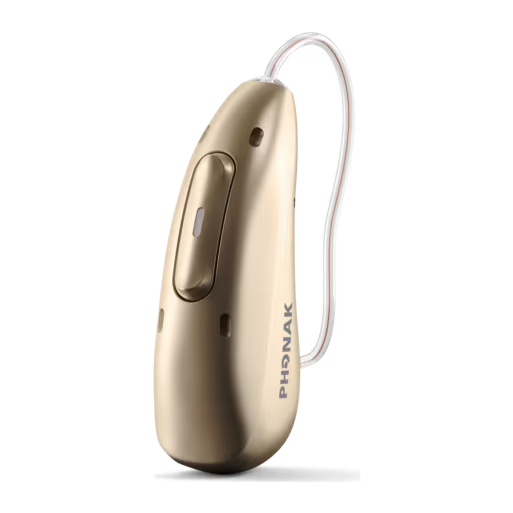
 | Dedicated processor for speech in noise | Current Sphere systems use a dedicated DEEPSONIC processor for network-based speech and noise separation in difficult environments. Phonak also uses machine learning in its automatic environmental system. Not every Infinio model carries that dedicated processor: the Audeo Infinio Ultra R and the Audeo Infinio Ultra Sphere are different products. |
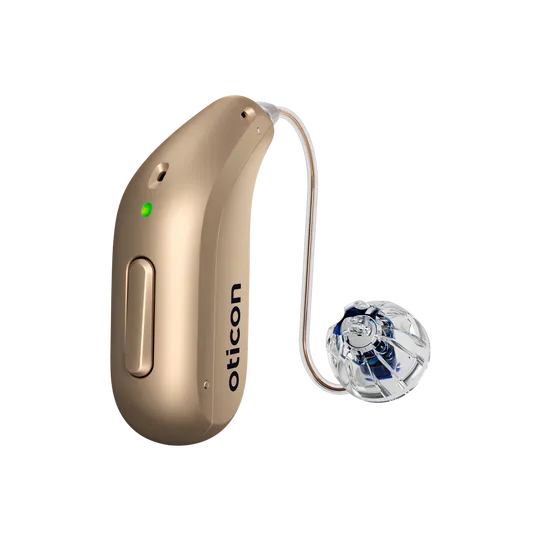
 | On-board network, plus movement and intent | Oticon has used on-board network processing since Oticon More. Its approach generally aims to preserve access to a broad sound environment while improving the contrast between meaningful sound and competing noise. Oticon Intent combines its network with head movement, body movement, conversation activity and the acoustic environment. |
 | Network denoising with multi-microphone directionality | ReSound has increasingly combined network denoising with multi-microphone directional processing, pairing environmental classification, beamforming and noise reduction rather than relying on any one of them. |
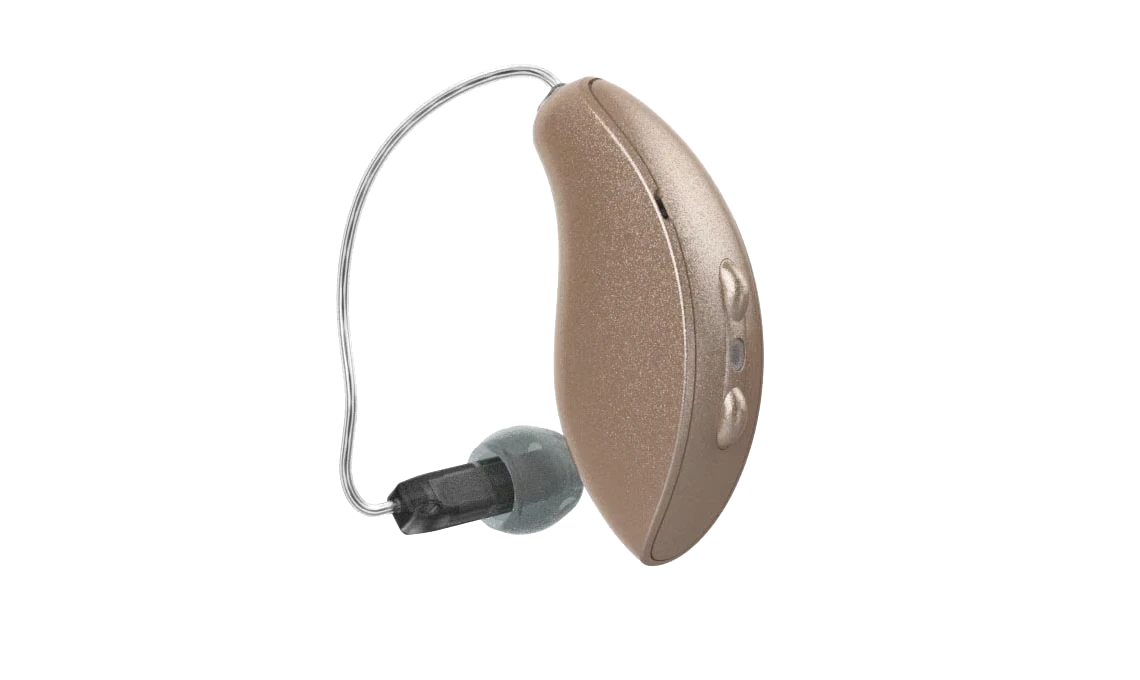
 | Sound processing plus embedded sensors | Starkey was an early company to market hearing aids explicitly around AI and embedded sensors. Modern Starkey systems use network processing for sound classification and speech and noise handling, and sensor processing for health and safety functions such as activity monitoring and compatible fall alerts. |
 | Conversation processing, plus a separate AI assistant | Signia uses conversation and directional processing in its Integrated Xperience platform. The Signia Assistant is a different use of AI again: a neural network system that helps personalise settings from the wearer’s feedback, with some of that processing done in the cloud. |
 | Machine learning personalisation | Widex has put substantial emphasis on personalisation. SoundSense Learn and related systems let the wearer make simple preference choices instead of adjusting technical parameters directly. Modern Widex apps offer further AI-assisted personalisation tools. |
 | Classification, moving into speech separation | Unitron uses machine learning environmental classification across its modern platforms. Its newer Moxi S-RX uses network-based SoundSonic360 processing designed to separate speech from competing noise. |
None of these approaches is automatically best for everyone. The useful question is whether the technology matches the environments where you personally struggle.
The useful question is not “which hearing aid has the most AI?” It is “what problem is its AI solving for me?”
What AI still cannot do
This is the part the advertising tends to leave out. Being clear about it now saves disappointment later.
-
It cannot restore biological hearing
A hearing aid processes sound. It does not regenerate damaged sensory cells or return the ear to how it worked before.
-
It cannot know for certain who you want to hear
Several people may be speaking at once. Direction, movement, acoustic characteristics and your own input all help the system make a better guess, but current hearing aids are not reading your mind.
-
It cannot remove every background sound
Speech and noise overlap. Removing noise aggressively also affects parts of speech and can make sound feel unnatural, so manufacturers have to balance clarity, comfort, awareness and sound quality.
-
It cannot guarantee the same benefit for everyone
Two people with similar audiograms can have very different ability to follow speech in noise. Research shows substantial individual variation in how much advanced processing helps.
-
It cannot replace a proper fitting
The processed signal still has to be amplified according to your hearing loss, the acoustics of your own ear and the levels you find comfortable.
-
It cannot make every difficult environment easy
Very noisy restaurants, large groups, distance and echoey rooms remain genuinely hard. A remote microphone or direct streaming from a television sometimes delivers a bigger improvement than another level of onboard processing.
Does an AI hearing aid record my conversations?
For normal hearing aid sound processing, the microphones have to analyse the sound around you continuously. That does not automatically mean the hearing aid is making or storing recordings of what you say. Many core sound processing systems run entirely inside the hearing aid.
But “AI hearing aid” covers a very broad range of products. Some optional app-based personalisation, assistant, transcription or translation features can involve a smartphone, an internet connection or a cloud service.
Hearing the room is not the same as recording the room.
If privacy matters to you, ask three specific questions before you buy: which features operate on the hearing aid itself, which need your phone, and whether any optional service sends information to a remote server.
Is AI worth paying more for?
A more expensive hearing aid can genuinely contain more sophisticated processing. The question is whether that processing solves a problem you actually have.
Advanced AI may matter more if you regularly
- eat in noisy restaurants
- attend family gatherings
- join group conversations
- sit in meetings
- move between lots of different environments
- struggle badly with competing voices
- want the hearing aids to make more decisions for you
The most expensive AI may matter less if
- most of your conversations happen in quiet
- your main problem is simply making quiet speech audible
- television is the main difficulty and direct streaming solves it
- you rarely enter complex listening environments
- the extra features do not address a problem you have
Paying more because the brochure says AI is not a good reason to buy a hearing aid. Paying more because you eat out three times a week and cannot follow the table is a very good one.
What matters more than the letters AI on the box
Even the most advanced processing system is only one part of a hearing aid. The device still needs to know which frequencies you are struggling to hear, how much amplification you need, how much sound is comfortable, how it is physically coupled to your ear, and how you are getting on in the situations that matter to you.
The technology only works properly when it is fitted to you
A manufacturer’s default fitting is only a starting point. Professional verification and follow-up adjustment help make sure the hearing aid is actually delivering the intended amplification in your ear, rather than what the software assumed.
A premium hearing aid cannot compensate for an inaccurate fitting. At TellyHear every hearing aid is programmed to your hearing before it is sent, with follow-up support to adjust it as you settle into wearing them.

Questions to ask before buying
Ignore the buzzwords. These are the questions that will actually tell you whether a hearing aid suits you, and any good clinician will be happy to answer all of them.
- What exactly is the AI doing in this hearing aid?
- Does it simply recognise the environment, or does it directly process speech and noise?
- Is the advanced feature automatic, or do I have to turn it on?
- Does it work at every technology level, or only the most expensive one?
- Does it need my phone or an internet connection?
- Does it affect battery life?
- How well does this model handle the situations where I personally struggle?
- Can I trial it in my normal life?
- Has my speech-in-noise ability been considered, not just my audiogram?
- How will the hearing aid be verified and fine-tuned after I receive it?
- Would a remote microphone or TV streamer be a better solution to my main problem?
What you are really looking for
Do not buy a hearing aid because AI sounds futuristic. Buy one because a particular piece of technology solves a listening problem you actually have.
For someone who spends a lot of time in restaurants and group conversation, sophisticated speech-in-noise processing can be genuinely valuable. For someone who mostly wants clearer television and easier one to one conversation at home, spending thousands more for the largest neural processor may make far less difference.
Your audiogram matters. Your speech-in-noise ability matters. Your everyday life matters. And the way the hearing aid is fitted matters. The AI label by itself tells you surprisingly little.
Common questions about AI hearing aids
Does more AI mean better hearing for me?
Not automatically. The right hearing aid depends on your hearing loss and on how much background noise you deal with day to day. Someone who is mostly at home may hear beautifully with a mid-range device, while a busy social life gets more from advanced speech-in-noise processing. There is no industry measure of how much AI a hearing aid contains, so the label by itself tells you very little.
Can AI fix or cure hearing loss?
No. No hearing aid, however clever, restores hearing you have lost. It processes the sound arriving at your ear so your brain has an easier job. Be cautious of any product that claims to bring your hearing back to normal.
Can AI remove all background noise?
No. Speech and noise overlap, so removing noise aggressively also removes parts of speech and can make everything sound unnatural. Manufacturers deliberately balance clarity against comfort, awareness and sound quality. The realistic goal is making a hard environment easier, not silent.
Does an AI hearing aid listen to or record my conversations?
The microphones have to analyse the sound around you continuously, but that is not the same as making or storing recordings. Most core sound processing runs inside the hearing aid itself. Some optional app features, such as assistants, transcription or translation, can involve your phone or a cloud service, so ask which features run where if privacy matters to you.
Does the AI work without a smartphone?
The main sound processing generally does. Environmental classification and speech-in-noise processing run on the hearing aid and work whether or not your phone is nearby. Features that learn your preferences usually need the app, because that is how you tell the system what you prefer.
Does the AI need the internet?
For everyday listening, no. Some personalisation assistants do use cloud processing, and Signia is explicit that its Assistant works that way. If you would rather nothing left the device, ask before you buy which features are on-device only.
Will my hearing aids learn my preferences automatically?
Usually not on their own. Most personalisation systems learn from choices you actively make in the app, such as picking between two versions of a sound. The hearing aid then remembers those preferences, sometimes tied to particular places.
Are AI hearing aids harder to use?
Generally the opposite. Automatic environment detection was designed to remove the old routine of switching between restaurant, quiet, music and outdoor programs. If you never want to touch an app, good automatic classification may be worth more to you than any headline feature.
Do I need the most expensive technology level?
Not necessarily. The extra money usually buys better performance in complicated, noisy, changing environments. If most of your listening happens in quiet, one to one, or in front of the television, a mid-range device fitted properly may serve you just as well. We will tell you honestly where the extra tier earns its price for you.
Is AI useful if I mostly stay at home?
Some of it. Automatic adjustment still helps as you move between the kitchen, the garden and the lounge. But the most expensive speech-in-noise processing is built for restaurants and group conversation, so it will make less difference if you rarely encounter those.
Can AI help in restaurants?
This is the situation it is most aimed at, and where recent research has shown the clearest gains. It will not make a loud restaurant feel like a quiet room, and how much it helps varies from person to person, but it is the single strongest reason to consider advanced processing.
What is a deep neural network?
It is a system trained by example rather than by written rules. During development, engineers expose it to very large amounts of audio containing speech, noise and mixtures of both, and it adjusts its internal settings until it becomes good at spotting the useful patterns. The trained result is then placed in the hearing aid. It is recognising acoustic patterns, not understanding what you are talking about.
Is a dedicated AI chip actually better?
A separate processor lets a manufacturer run a larger network in real time without draining the battery, which matters for the hardest speech-in-noise work. It is a genuine engineering difference. It is not a guarantee of a better result for you, because a bigger network aimed at one problem may not help with the problem you actually have.
Does AI replace an audiologist?
No. The processing still has to be amplified to match your hearing loss, your ear acoustics and the levels you find comfortable, then checked and adjusted as you settle in. A manufacturer default fitting is a starting point, not a finished result.
Are all manufacturers using AI in the same way?
No, and this is the most useful thing to understand before you start shopping. One company may use it to classify your environment, another to separate speech from noise, another to learn your preferences, another to process movement data. Two hearing aids can both say AI on the box and be solving completely different problems.
Sources and further reading
Independent research and manufacturer material are listed separately, because a manufacturer testing its own algorithm is not the same as an independent study. Exact citations are being finalised and will be linked here.
Independent and peer-reviewed research
- Deep neural network noise reduction in hearing aids and speech-in-noise outcomes, clinical studies 2025 to 2026 (link pending)
- Combined neural network denoising and beamforming in older adults: speech recognition, clarity and listening effort (link pending)
- Noise reduction and listening effort, including cases where word recognition changes little (link pending)
- Real-ear verification of hearing aid fittings compared with manufacturer first-fit settings (link pending)
- History and impact of commercially successful fully digital hearing aids from 1996 (link pending)
Manufacturer technical material
- Phonak: Sphere architecture, DEEPSONIC processor and Spheric Speech Clarity, including which Infinio models carry it (link pending)
- Oticon: on-board deep neural network from Oticon More, and the 4D sensor approach in Oticon Intent (link pending)
- ReSound: deep neural network noise reduction and multi-microphone directionality (link pending)
- Signia: the Signia Assistant, including its use of cloud processing (link pending)
- Widex: SoundSense Learn preference personalisation (link pending)
- Starkey and Unitron: current classification and speech separation processing (link pending)